
 Posted by
Explore the sociology of social cognition and see how culture, schemas, and bias shape the way we perceive others, plus simple ways to rethink snap judgments. I still remember my first day at my first real job, standing in a break room full of strangers and deciding, within about four seconds, who looked friendly, who looked intimidating, and who I should probably avoid. Nobody had said a word to me yet. So where did those snap judgments come from? That question is the doorway into the sociology of social cognition, and honestly, it has bugged me ever since.
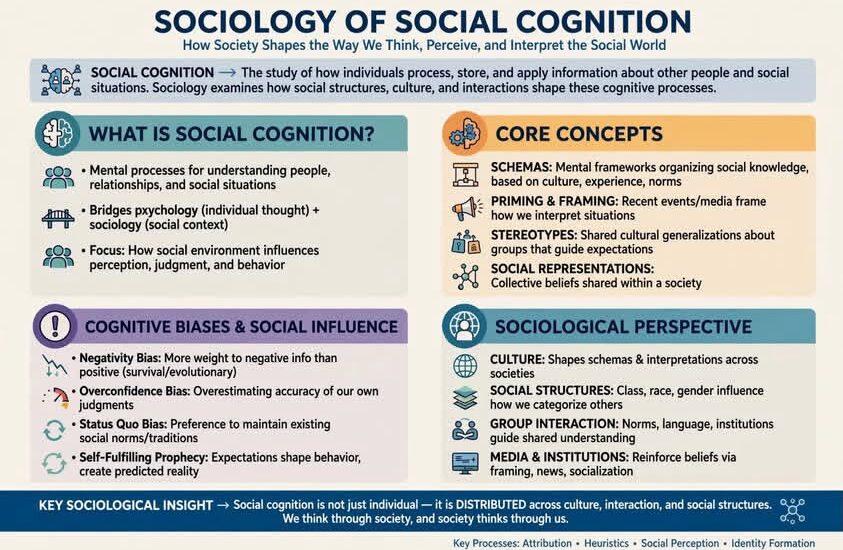
Here is the short version. Social cognition is the way we process, store, and use information about other people. Social perception is the part where we actually size people up. Psychologists have studied both for decades, but sociologists ask a different question. They want to know how society itself, with its norms, classes, and shared stories, teaches us what to notice in the first place. I find that angle far more interesting, because it means my brain is not working alone. It is working with a huge invisible crowd.
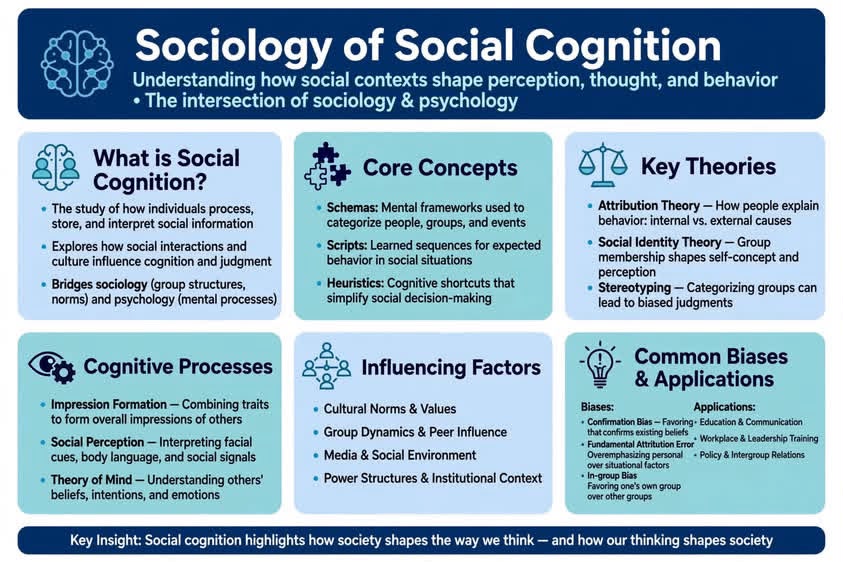
Think about schemas for a second. A schema is a mental shortcut, a kind of template that helps us sort the messy world into tidy categories. A teacher, a doctor, a teenager on a skateboard: each one arrives in our heads with a pre-packaged set of expectations. Those templates are useful, no doubt about it. Without them I would need to rebuild my understanding of the world every morning. But here is the catch. Schemas do not fall from the sky. They are handed to us by family, school, media, and the neighborhood where we grew up. In other words, they are social products.
My grandmother was a good example, though she would have hated being called one. She believed she could tell a person’s character by the way they shook hands. Firm grip, trustworthy. Limp grip, shifty. She was wrong about as often as she was right, yet she never doubted it, because everyone in her small town shared the same belief. That shared confidence is exactly what sociologists mean when they talk about the social construction of reality. We agree, mostly without noticing, on what things mean, and then we treat those agreements like facts.
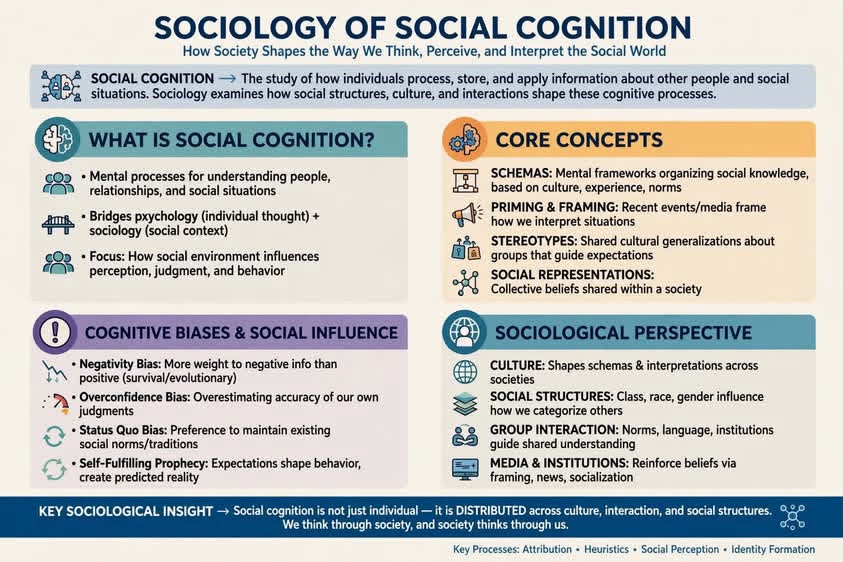
Now, this is where social perception gets a little uncomfortable. Stereotypes and implicit bias grow out of the same machinery. If my culture keeps showing me one type of person as a leader and another type as a helper, my brain quietly absorbs the pattern. I do not choose it. I do not even feel it happening. Then, when I meet someone new, the pattern fires before my thoughtful, fair-minded self has a chance to speak up. Have you ever caught yourself making an assumption and then felt a bit embarrassed? I certainly have, more times than I would like to admit.
Social identity matters here too. We love to sort ourselves into groups, whether by hometown, profession, religion, favorite football team, or anything else. Once we belong somewhere, we tend to view our own group with a generous eye and everyone else with a narrower one. Researchers call this the in-group and out-group effect, and it shows up in surprisingly trivial settings. I once watched two groups of coworkers argue for a full week about the office thermostat as though it were a matter of national security. Silly, yes, but it was social perception in action: us versus them, over a number on a dial.
Context plays a huge role as well. The same behavior can look confident in one culture and rude in another. Direct eye contact signals honesty in many Western settings, while in parts of East Asia it can feel confrontational, or at least a bit too intense. I learned this the awkward way during a trip abroad, when I kept staring politely at a host who kept looking politely at the floor. We both left that dinner convinced the other person was strange. Neither of us was. We were simply running different cultural software.
So what do we do with all this? I do not think the answer is to throw away our mental shortcuts, because that is not possible anyway. What I try to do instead is slow down a little. When I notice a quick reaction to someone, I ask myself where it came from. Was it something the person actually did, or was it a story I picked up long ago? That tiny pause is not glamorous, but it changes a surprising number of interactions.
It also helps to widen the crowd. Reading outside my usual bubble, talking with people whose lives look nothing like mine, and sitting with the discomfort of being wrong all loosen the grip of those inherited templates. Sociologists often point out that perception shifts when social contact shifts, and my own experience backs that up. The coworker I avoided on day one, by the way, turned out to be one of the kindest people I have ever known. So much for my four-second verdict.
Reference
Allport, G. W. (1954). The nature of prejudice. Addison‑Wesley.
Argyle, M., & Cook, M. (1976). Gaze and mutual gaze. Cambridge University Press.
Berger, P. L., & Luckmann, T. (1966). The social construction of reality: A treatise in the sociology of knowledge. Anchor Books.