 Posted by
Explore the sociology of alternative medicine and why people turn to healing practices beyond the clinic, from holistic health to medical pluralism. Last winter my aunt stopped taking my calls for about two weeks. When she finally picked up, she told me she had been spending her afternoons at a small acupuncture clinic above a bakery, and that she felt better than she had in years. I will admit my first reaction was a raised eyebrow. But then she said something that stuck with me: the practitioner listened to her for an entire hour. One hour! When did a doctor last give her more than eight minutes?
That one comment pulled me straight into the sociology of alternative medicine, a field that asks not whether a remedy works in a lab, but why people choose it, who gives it legitimacy, and what it means to them. I am no clinician. I am simply someone who has spent a lot of time wondering why healing practices outside the hospital walls keep growing instead of fading away.
Let me start with the obvious. Modern biomedicine is brilliant at fixing broken bones, fighting infections, and keeping heart attacks from becoming funerals. Yet sociologists have long pointed out that it can feel cold. Appointments are short, language is technical, and patients often leave feeling like a set of lab values rather than a person. Alternative medicine, or complementary and alternative medicine as researchers often call it, steps into that gap. Herbalists, reiki practitioners, chiropractors, ayurvedic healers, and naturopaths tend to offer time, touch, and a story about why you are sick. And a story, honestly, matters more than we like to admit.
Sociologists talk about the “illness experience,” which is basically the lived, messy side of being unwell, separate from the disease itself. You can have a diagnosis and still feel confused, scared, and alone. Many alternative healing practices speak directly to that part. They treat the whole person, which is why you hear the phrase holistic health everywhere. Whether every claim holds up is another question, and a fair one, but the appeal is not hard to understand.
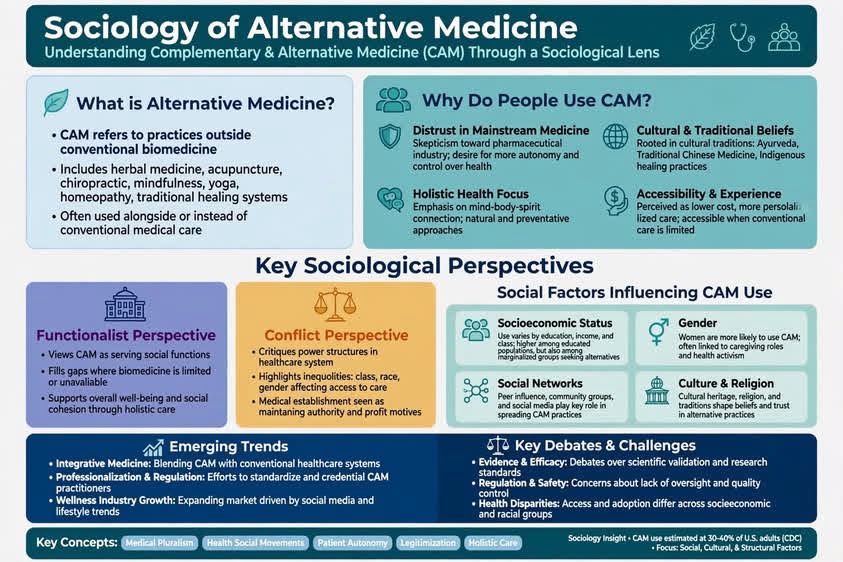
I also think about my grandmother, who grew up in a village where the local healer mixed bitter herbs and murmured prayers over a sick child. Nobody there called it “traditional healing” or “alternative.” It was just medicine. The word alternative only appears when a dominant system exists to be an alternative to. That is a very sociological point, and it took me years to really see it. Power decides what counts as mainstream, and history, politics, and professional lobbying decide the rest. In the nineteenth century, for instance, doctors in many countries fought hard to push out rival healers, and the medical profession gained its authority partly through that fight.
Then there is the idea of medical pluralism, which simply means that most people use more than one system of care. I do this myself. I will take antibiotics for a stubborn infection and, in the same week, drink ginger tea because my mother swears by it. Research across many countries shows that this mixing is normal rather than strange. People move between pharmacy shelves and herbal shops without feeling any contradiction at all. Is that irrational? I do not think so. It looks more like people pragmatically assembling a toolkit.
Of course, social factors shape these choices too. Cost matters. Access matters. Trust matters a great deal, especially for communities that have been dismissed or mistreated by formal health systems. When someone has felt ignored in an emergency room, a warm room that smells like lavender and a healer who remembers their name can feel like respect. I have seen this play out, and it is not about gullibility. It is about dignity.Now, I would be dodging if I did not mention the placebo effect, because it comes up in nearly every conversation about alternative medicine. Expectation, ritual, and care can genuinely change how people experience pain and fatigue. Skeptics sometimes use this to wave the whole field away, but sociologists find it more interesting than that. If the healing ritual helps someone feel calmer and more in control, the social meaning of the encounter is doing real work, even when the active ingredient is debated.
None of this means everything labeled natural is safe. Some practices are harmless, some are helpful, and a few can be dangerous, especially when they replace proven treatment for serious illness like cancer. I feel strongly about that. The healthiest approach, I think, is curiosity paired with caution: ask questions, tell your doctor what you are trying, and keep your skepticism and your compassion in the same pocket.My aunt, by the way, still goes to that clinic. She also still sees her physician, and she told me last month that the two have started, very awkwardly, to talk to each other. That felt like a small victory.
So where does that leave us? Probably with a more honest picture of health care, one where healing is never only about chemistry. It is about belonging, trust, being heard, and making sense of suffering. The sociology of alternative medicine does not ask us to pick sides. It asks us to notice why so many people walk through those doors, and what that says about the rest of the system they left behind.
Reference
Kaptchuk, T. J., Friedlander, E., Kelley, J. M., Sánchez, M. N., Kokkotou, E., Singer, J. P., Kirsch, I., … Lembo, A. J. (2010). Placebos without deception: A randomized controlled trial in irritable bowel syndrome. PLoS ONE, 5(12), e15591. https://doi.org/10.1371/journal.pone.0015591
National Center for Complementary and Integrative Health. (n.d.). Complementary, alternative, or integrative health: What’s in a name? National Institutes of Health. https://www.nccih.nih.gov/health/complementary-alternative-or-integrative-health-whats-in-a-name
Saks, M. (2003). Orthodox and alternative medicine: Politics, professionalization and health care. Sage.