
 Posted by
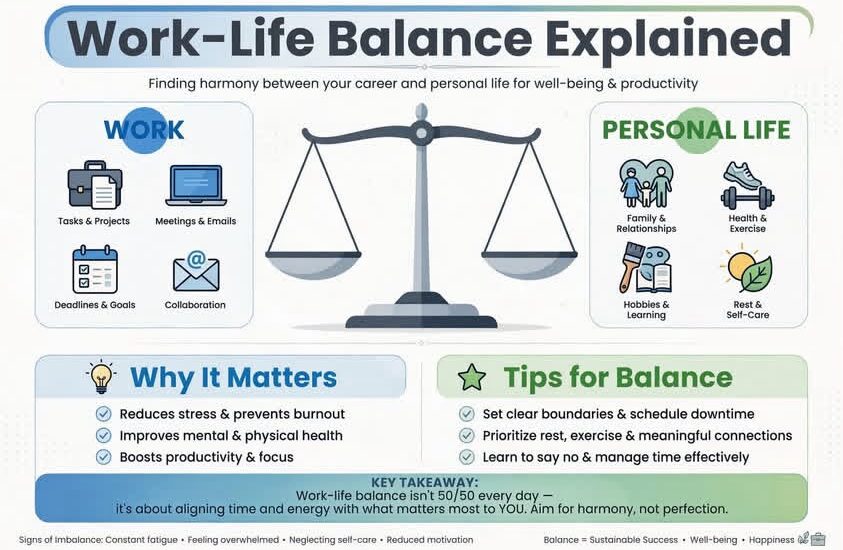
 Discover what sociology says about work-life balance, from boundary theory to spillover effects, and why real balance is more structural than personal. I want to start by admitting something. I used to think work-life balance was a personal failing, mine specifically, something I could fix if I just bought the right planner or woke up forty-five minutes earlier. It took reading actual sociology of work-life balance research for me to realize that framing was almost entirely wrong. Balance is not a discipline problem. It is a structural one, shaped by boundaries most of us never chose and rarely notice until they collapse.
Sociologists who study work-life balance tend to lean on something called boundary theory, or its close cousin, border theory. The idea, developed by scholars like Sue Campbell Clark, is that we all live across different domains, home, work, sometimes a third space like school or caregiving, and we spend enormous psychological energy managing the borders between them. Some borders are physical, a commute, an office door, a closed laptop. Some are temporal, the hours we agree to work. Some are just in our heads, the mental switch we try to flip when we walk in the front door. When those borders are thick and clear, people report feeling more balanced, and when they get thin and permeable, which is basically the story of remote work over the last several years, balance gets harder to hold onto, even when the actual hours logged do not change much.
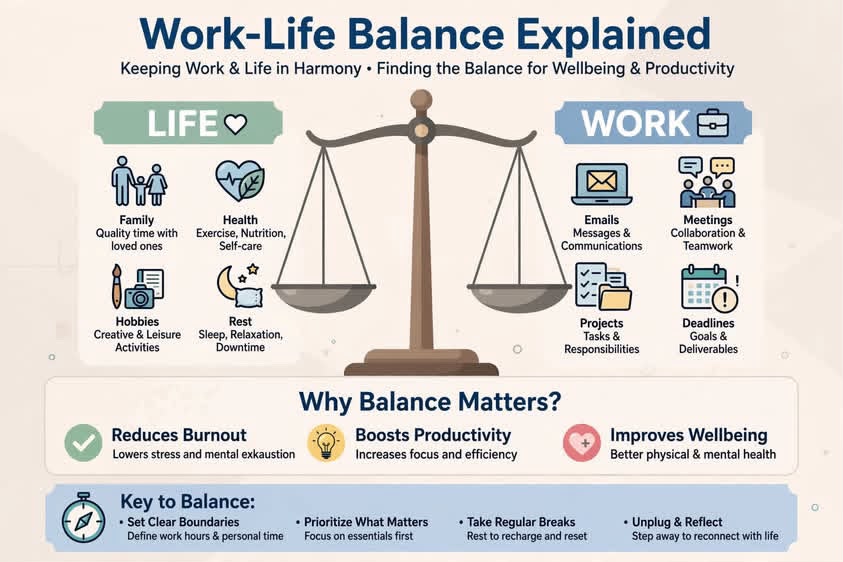
Here is a small confession. For about two years I worked from a corner of my bedroom. My laptop sat six feet from where I slept. Do you know what that does to a border? It erases it. I would answer emails at ten at night because the device was simply there, glowing, insisting. Sociologically speaking, I had a segmentation problem, meaning I had collapsed two domains that used to stay separate, and my sense of balance suffered even though I was, on paper, working fewer hours than I had at the office.
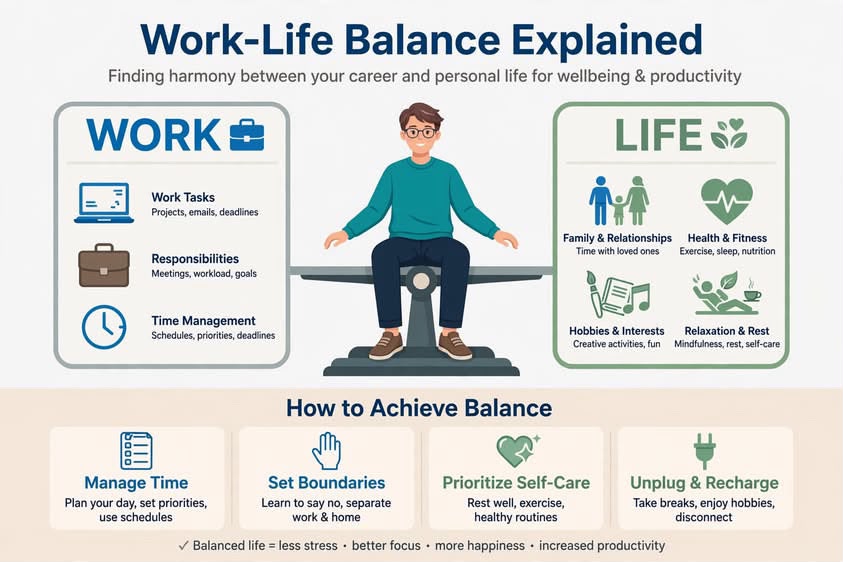
This lines up with national data. The Bureau of Labor Statistics tracks how Americans spend their time through the American Time Use Survey, and recent figures show that roughly a third of employed people now do some or all of their work from home on days they work, while a majority still work entirely at their workplace. Full-time workers logged an average of about eight hours on days they worked, which sounds unremarkable until you consider how differently that time feels depending on where the borders sit. Working from a kitchen table with a toddler nearby produces a very different lived experience of work life balance than working from a dedicated office, even with the same hour count. This is exactly what boundary theory predicts and exactly what raw hour counts miss.
There is also the matter of role conflict, another concept sociologists use when they talk about work-life balance. Inter-role conflict theory, which sits alongside boundary and spillover models, argues that we hold multiple roles, employee, parent, partner, and those roles compete for the same finite hours and the same finite attention. I think about this every time I am half listening to a work call while also half listening for my kid to walk through the door. Am I doing either role well in that moment? Probably not, and yet that fractured attention has become so normal that we rarely stop to name it as a sociological pattern rather than just modern life.
Spillover theory offers another angle, and I find it useful because it explains the emotional residue that hours worked never captures. Spillover says that mood, stress, and energy cross from one domain into another, so a rough meeting at two in the afternoon can quietly ruin an evening that has nothing to do with work. Anyone who has snapped at a family member for no good reason after a bad day at the office has lived spillover theory without knowing its name. This is why work-life balance interventions that only touch hours, shorter weeks, flexible scheduling, and so on, sometimes underperform. They address the border but not the residue that leaks across it.
What strikes me most, looking at this from a sociology of work-life balance lens rather than a personal productivity lens, is how much of this is not really about individual choices at all. It is about who has the power to set and enforce boundaries in the first place. A senior employee with negotiating leverage can build thick borders, no emails after six, no weekend Slack messages. Someone with less job security often cannot, and the boundary erodes not because of weak willpower but because of an actual power imbalance. Sociologists sometimes call this boundary control, and it deserves more attention than it usually gets in casual conversations about balance, which tend to stay individualized and a little moralizing.
Reference
Ashforth, B. E., Kreiner, G. E., & Fugate, M. (2000). All in a day’s work: Boundaries and micro role transitions. Academy of Management Review, 25(3), 472–491. https://doi.org/10.5465/amr.2000.3363315
Bureau of Labor Statistics, U.S. Department of Labor. (2026, March). American Time Use Survey — 2025 results [News release]. https://www.bls.gov/news.release/atus.htm
Clark, S. C. (2000). Work/family border theory: A new theory of work/family balance. Human Relations, 53(6), 747–770. https://doi.org/10.1177/0018726700536001