
 Posted by
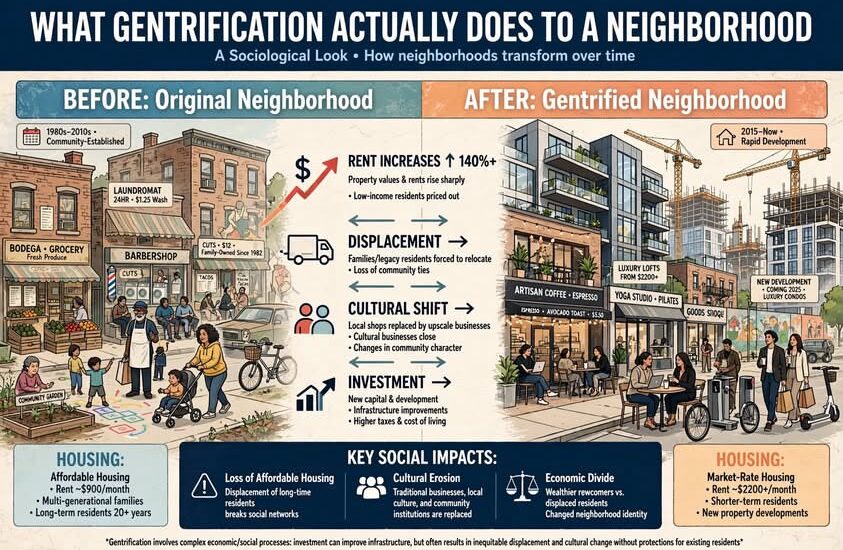
 A neighborhood sociologist explores gentrification’s real cost: lost social capital, urban displacement, and who cities are actually built for. I used to live two blocks from a laundromat that got turned into a cold brew bar within the span of about fourteen months. I am not exaggerating for effect here. One month it was washing machines and a guy named Lou who fixed the change machine with a screwdriver he kept in his back pocket, and the next it was reclaimed wood countertops and a barista explaining the tasting notes of a coffee that cost more than a load of laundry used to. That is gentrification in a nutshell, though of course it is never actually that simple, and that is sort of the whole point of this post.
Gentrification, from a sociological standpoint, is not just about rising rent or trendy coffee shops replacing old businesses, even though that is usually the visible symptom everyone points to first. It is a process of urban transformation where wealthier, often whiter, residents move into historically lower income neighborhoods, and the social fabric of that place starts to shift in ways that are hard to reverse. Property values climb. Long term residents, many of whom built community networks over decades, find themselves priced out or socially displaced even if they are not physically forced to leave right away. Sociologists like Ruth Glass, who coined the term back in the 1960s in London, were already noticing this pattern of displacement long before it became the buzzword it is today.
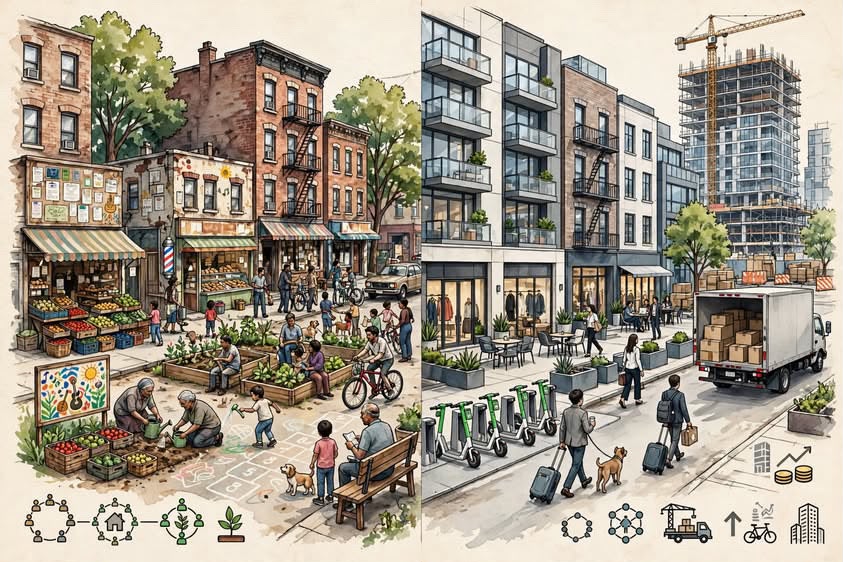
Why does this matter so much, and why do I keep thinking about that laundromat? Because urban displacement is not just an economic story. It is a story about identity and belonging. When a neighborhood gentrifies, it does not just lose its affordable housing stock, though that is a massive part of it. It loses its informal institutions too, the barbershops where three generations of men got their hair cut, the corner stores that extended credit to families they trusted, the churches that anchored entire blocks. Once those go, they rarely come back, and what replaces them tends to serve a very different demographic with very different needs.
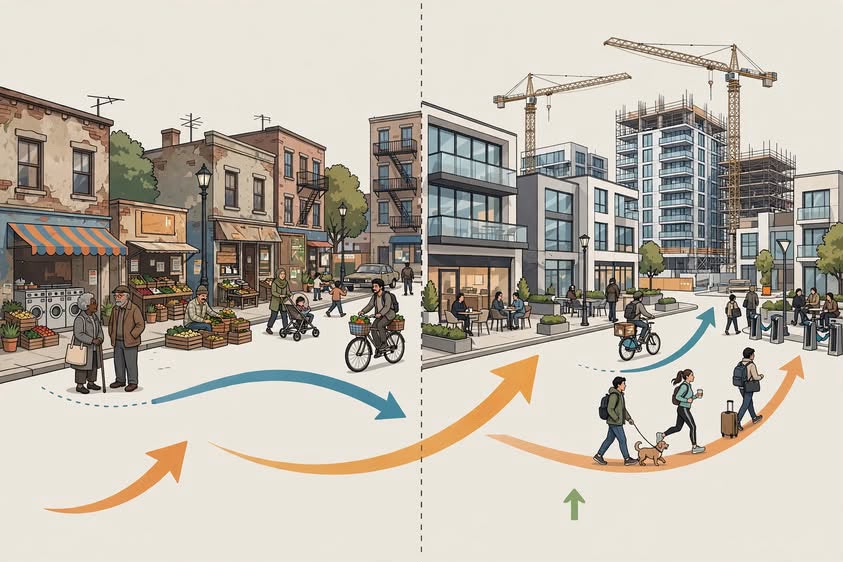
I think about social capital a lot when I read about this stuff. Pierre Bourdieu wrote extensively about how capital is not only financial, it is also social and cultural, and gentrification tends to erode the social capital that longtime residents relied on even while it increases the economic capital of the area overall. Is that a fair trade? I genuinely do not think it is, though I understand why city planners and developers frame it that way. New tax revenue does fund schools and infrastructure, sure, but who actually benefits from that revenue if the original residents have already been pushed out to the periphery?
There is also this idea of the “gentrifier’s guilt,” which is not really an official sociological term but should probably be one. I have felt it myself, honestly. Moving into a neighborhood because the rent is cheaper than where you used to live, only to realize months later that your presence, along with a hundred other people making the exact same calculation, is part of what drives the rent up for everyone else. It is uncomfortable to sit with. Sociologists sometimes call this the “third wave” gentrifier, someone who is not a developer or an investor but still contributes to the pressure simply by being there, by wanting exposed brick and a walkable neighborhood and good school ratings.
Race complicates this even further, and I do not think you can talk about gentrification honestly without talking about race. Urban renewal projects in the mid twentieth century, redlining, and decades of disinvestment in predominantly Black and Latino neighborhoods created the very conditions that made those areas “affordable” for new residents decades later. So when gentrification arrives, it is not landing on neutral ground. It is landing on ground that was shaped by policy decisions meant to exclude, and now that same ground is suddenly desirable again once wealthier, often white, residents start moving in. That is not a coincidence. That is a pattern researchers have documented across dozens of American cities.
What frustrates me most, and I say this as someone who studies this stuff casually and lives inside of it constantly, is that the conversation often gets flattened into “gentrification bad” or “gentrification good, more tax revenue,” when the sociology of it is so much messier than either extreme. Community displacement does not happen overnight. It happens in a thousand small transactions, a rent increase here, a beloved diner closing there, a new development with “luxury” in its name going up where a public housing complex used to stand.
So where does that leave us? I honestly do not have a tidy answer, and I am suspicious of anyone who claims they do. What I do think is that understanding gentrification through a sociological lens, rather than a purely economic one, forces us to reckon with questions of who a city is actually for. Is it for the people who built it, culturally and socially, over generations? Or is it for whoever can afford to move in next? Maybe the answer changes neighborhood by neighborhood. But I still think about Lou and his screwdriver sometimes, and I wonder what happened to him after the laundromat closed.
Reference
Bourdieu, P. (1986). The forms of capital. In J. G. Richardson (Ed.), Handbook of theory and research for the sociology of education (pp. 241–258). Greenwood.
Ellen, I. G., & Ding, L. (2016). Advancing our understanding of gentrification. Cityscape, 18(3), 3–8. U.S. Department of Housing and Urban Development, Office of Policy Development and Research.
Glass, R. (1964). Introduction: Aspects of change. In Aspects of Change (pp. xx–xx). Centre for Urban Studies, University College London.