
 Posted by
 Discover how the sociology of the body and health explains why illness, pain, and wellness are shaped by culture, class, and gender, not just biology alone. I did not expect a stiff back to turn into a small obsession with sociology, but that is exactly what happened to me last winter. I pulled something while shoveling snow, of all things, and spent two weeks moving like a much older version of myself. What struck me was not the pain itself but how differently people reacted to it.
My doctor wanted scans. My grandmother wanted me to rest and drink tea. A coworker insisted I just needed to stretch more before lifting anything heavy. Three completely different explanations for the same ache in my lower back, and that is when it hit me. Health is never just biology. It is also a story we tell, shaped by culture, class, and the era we happen to live in.
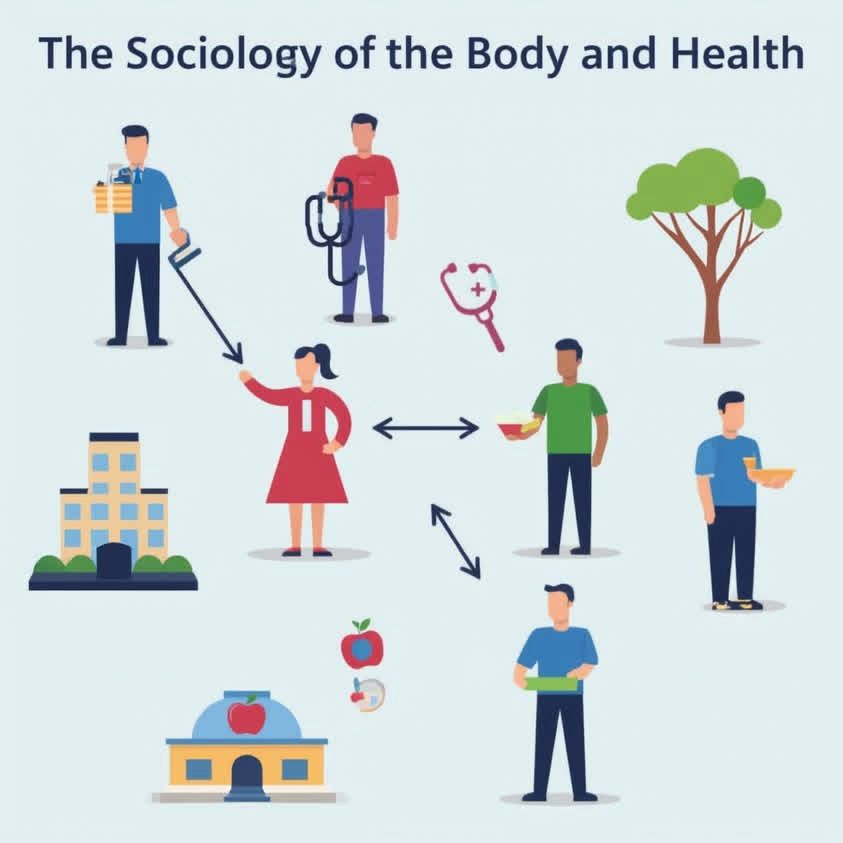
The sociology of the body and health is built on a simple but slippery idea. Our bodies are physical, sure, but they are also social objects. They get read, judged, medicalized, and disciplined by the world around them. Think about how differently a limp is treated depending on who is doing the limping. An athlete gets sympathy and a training plan. An elderly person sometimes gets written off as just getting old. A person without health insurance might just learn to live with it. The body does not exist outside of society. It exists inside of it, constantly being interpreted by people who are not actually inside that body.
I think about Michel Foucault a lot when this subject comes up, even though I first read him for an entirely different class years ago. His idea of the medical gaze always stuck with me, this notion that modern medicine does not simply observe the body but actively produces what counts as healthy or deviant in the first place.
Once I understood that, I started noticing it everywhere. Why do we measure health in terms of charts built largely around mid-twentieth century populations? Why does chronic pain in women so often get dismissed as anxiety, while the same symptoms in men get investigated more aggressively? These are not just medical questions. They are sociological ones, wrapped in quiet assumptions about gender, race, and whose pain gets believed in the first place.
Social class plays an enormous role here, too, maybe more than people want to admit. Where you live, what you eat, how much stress your job puts on your nervous system, whether you have time to exercise or see a doctor when something feels off, all of that gets stamped onto the body slowly over time. Researchers call these social determinants of health, and honestly, the term almost undersells how powerful they really are. A zip code can predict life expectancy better than almost anything else, which says a great deal about how unevenly wellness gets distributed across a single country, let alone the world.

There is also the matter of how illness becomes identity. Anyone who has spent real time in a hospital waiting room knows what I mean. You stop being just a person and start becoming a diagnosis, a chart, a set of symptoms other people discuss in front of you, as if you are not even there.
Sociologists describe this as the sick role, a concept that traces back to Talcott Parsons, who argued that society grants certain privileges to the sick, like being excused from work, but only if the sick person is also trying to get better. It sounds almost transactional when you put it that way, does it not? Get sick, but get sick correctly, and only for an acceptable amount of time.
What I find genuinely fascinating, and a little unsettling if I am honest, is how much of what we consider normal health behavior is shaped by social pressure rather than pure biology. Body image is probably the clearest example of this. I grew up watching the ideal body shift in advertisements and movies almost decade by decade, and I cannot pretend those images did not shape how I felt about my own reflection in the mirror. The body becomes a site where social expectations get carved directly into self-perception, which then ripples outward into eating habits, exercise routines, and whether someone even feels comfortable walking into a gym.
By the time my back finally healed, I had stopped thinking about it as just an injury. It had become this small case study in how bodies get filtered through layers of meaning long before anyone actually diagnoses them. The sociology of the body and health is not some abstract academic corner reserved for textbooks. It shapes who gets believed when they say they are in pain, who gets treated with urgency, and who gets quietly told to walk it off and move along. Once you start noticing that pattern, it is genuinely hard to stop.
Reference
Commission on Social Determinants of Health. (2008). Closing the gap in a generation: Health equity through action on the social determinants of health. World Health Organization. https://www.who.int/publications/i/item/WHO-IER-CSDH-08.1
Foucault, M. (1973). The birth of the clinic: An archaeology of medical perception (A. M. Sheridan Smith, Trans.). Pantheon Books. (Original work published 1963)
Turner, B. S. (2008). The body and society: Explorations in social theory (3rd ed.). SAGE Publications.