
 Posted by
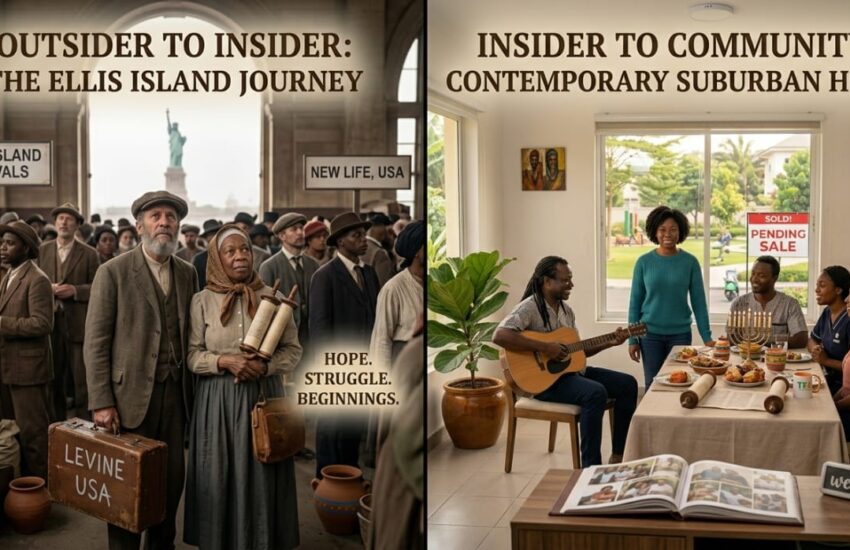
 I have often thought about what it means to be Jewish in America. It’s a question my grandparents, who fled Eastern Europe, could never fully answer, and one I still wrestle with today. It is a story of fitting in while standing out, of preserving a unique heritage while embracing a new home. The Jewish American experience is a powerful lens through which to view the broader American promise and its enduring tensions.
The journey of Jewish Americans is not a simple, linear path from immigrant to citizen. It is a story of navigating a complex racial and ethnic landscape. Historian Eric L. Goldstein explores how Jews, who were not always considered white in America, negotiated their place in the country’s deeply ingrained black-and-white racial dichotomy. For generations, Jewish immigrants and their children understood that their membership in “white America” was often conditional, contingent on their conformity to prevailing racial norms and on the eradication of their perceived distinctiveness. This was a trade-off that shaped how Jewish Americans saw themselves and their place in the world for decades.
The American Jewish story is also deeply intertwined with the African American experience. At the turn of the twentieth century, Jews and Black Americans often lived in close proximity in the urban centers of the Northeast, such as Harlem and sections of New York City. There was a shared sense of “otherness,” and Jewish immigrants were often at the forefront of civil rights activism, seeing parallels between their own struggles for freedom and the fight for racial equality. The alliance between these two communities was a significant force in American history, built on shared ideals of justice. However, as Jews moved into the suburbs and achieved economic success, this alliance became more complicated. The relationship, once seen as a “natural alliance,” began to fracture, shaped by differing socioeconomic realities and, as some have argued, by increasing political and cultural divergence on issues like Zionism and racial politics.

But what does it mean to be a “model immigrant”? Some scholars have pointed to the Jewish American experience as a kind of success story. Eastern European Jews were often praised for their rapid economic advancement and integration into American society. This narrative was often used to highlight the promise of the American Dream. Yet the path to success was not easy, and it came with profound challenges. The pressure to assimilate was immense, leading to internal conflicts within families and communities about how to preserve a distinct Jewish identity in a culture that prized uniformity.
This struggle between assimilation and preservation is a defining theme of the Jewish American experience. The late nineteenth and twentieth centuries saw a flourishing of Jewish-American fiction, which grappled with these themes of identity, faith, and diaspora. From the works of Philip Roth to Michael Chabon, Jewish-American authors have used their art to explore the complexities of being “outsiders” who are also “insiders”. Their narratives capture the ongoing dialogue with tradition, the negotiation of cultural boundaries, and the attempt to build a life in a new world while carrying the weight of an ancient one.
The anxiety of assimilation is not just an internal struggle. As early as the late nineteenth century, some observers wondered if success would be the downfall of American Jewry. Today, there are concerns about intermarriage and the dilution of Jewish tradition. As a nation that prides itself on pluralism, the United States forces its citizens to constantly renegotiate their identities. For Jewish Americans, this has meant embracing the opportunities of a new home while ensuring the survival of a culture that is always just a few generations from being lost.
And then there is the shadow of anti-Semitism. It is the persistent, unwelcome guest at the table. Jewish Americans have always had to navigate a world where they are both an integral part of society and its occasional target. Anti-Semitism has taken many forms in America, from overt discrimination to more subtle forms of exclusion. While the United States has largely been a haven for Jews, the threat of anti-Semitism is a constant in the collective Jewish psyche, shaping everything from where people choose to live to how they choose to express their identity. In the online age, anti-Semitism has also found new platforms, from social media to university campuses.
The Jewish American experience is a testament to the power of resilience and the complexity of identity. It is a story of how a people can both assimilate and retain their distinctiveness, how they can be both American and Jewish. The journey continues today, as a new generation grapples with these same questions in a changing world. It is a story I will always be a part of, and one that remains as vital and relevant as ever.
References
National Humanities Center. (n.d.). *The American Jewish experience in the twentieth century*. https://nationalhumanitiescenter.org/tserve/twenty/tkeyinfo/jewishexpb.htm
University of Wisconsin–Madison. (2021). *The American Jewish experience: From shtetl to suburb*. https://history.wisc.edu/wp-content/uploads/sites/202/2021/02/history219-fall2020-tonymichels.pdf
The Pluralism Project. (n.d.). *The challenge of assimilation*. https://pluralism.org/the-challenge-of-assimilation
Dollinger, M. (n.d.). *Jewish identities in 20th-century America*. https://www.policyarchive.org/download/10171
BJPA. (n.d.). *The quest for Jewish identity in America*. https://www.bjpa.org/content/upload/bjpa/the_/THE%20QUEST%20FOR%20JEWISH%20IDENTITY%20IN%20AMERICA.pdf