
 Posted by
 For years, I believed that health was mostly about personal choices. Eat well, exercise, see a doctor. I thought that if people just made better decisions, they would be healthier. Then I started looking at the data, and everything I thought I knew fell apart. Race does not determine health. But racism does, and the evidence is overwhelming.
A 2026 report from the Commonwealth Fund found that racial and ethnic health disparities persist in every single state, even after some gains in coverage following the pandemic . Native, Hispanic, and Black communities experienced generally worse care access and affordability than white communities across the country. Dr. Joseph Betancourt, president of the Commonwealth Fund, warned that recent federal cuts to health programs are likely to widen these already persistent gaps .
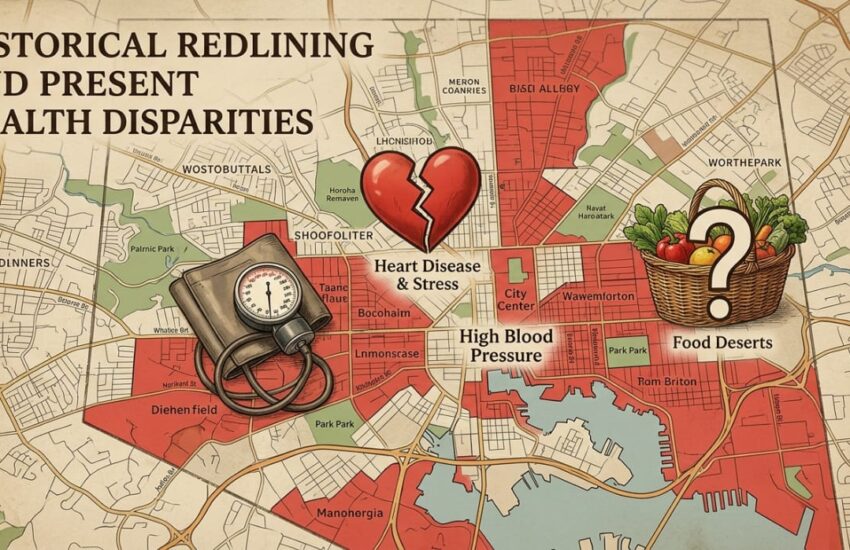
The pathways through which racism harms physical health are multiple and interconnected. One of the most insidious is residential segregation, rooted in discriminatory housing practices like redlining. Redlining was a government-backed practice from 1933 to 1968 that denied mortgages to residents of predominantly Black neighborhoods, marking them as “hazardous” . A preliminary study presented at the American Heart Association’s Scientific Sessions found that people living in historically redlined neighborhoods had higher rates of Type 2 diabetes, high blood pressure, heart disease, and obesity . The study also found a direct link between redlining, reduced access to healthy food, and higher disease prevalence . The legacy of those policies continues to shape health outcomes decades later.
Even when minority communities access care, the quality of that care is often lower. Black Medicare beneficiaries are more likely than white beneficiaries to be admitted to the hospital or seek emergency care for conditions that could be managed through good primary care . Black women die from breast cancer at the highest rate of any group in nearly every state, despite getting preventive mammograms. The reason may be delays in follow-up care and a lack of affordable coverage for imaging or biopsies after abnormal results . In all but eight states, Black and Hispanic children are less likely to have age-appropriate preventive dental visits and other care compared to white children . These gaps are not accidents. They are the result of a system that has systematically failed to serve certain communities.
Medical devices and research have racial blind spots built into their design. Pulse oximeters, which measure oxygen saturation, produce less accurate readings on fingertips with darker skin . Electroencephalogram electrodes used in neuroimaging research do not collect reliable data when used on scalps with thick, curly hair . A lack of images depicting darker skin in medical textbooks contributes to higher rates of underdiagnosis or misdiagnosis in patients with darker skin . Most participants in clinical trials are white, meaning there is insufficient data to develop evidence-based recommendations for people from racial and ethnic minority groups .
The stress of experiencing discrimination also takes a physical toll. Racism produces unjust outcomes and treatment for members of racial and ethnic minority groups, and these negative experiences serve as stressors that over time have a negative impact on physical health, leading to high blood pressure and hypertension . This is not about personal weakness. It is about the cumulative burden of navigating a society that treats you as lesser.
A 2024 study examining trends in Georgia and five neighboring states found that while population-level improvements have been seen in health insurance rates, mortgage and rental burden, and educational attainment, meaningful gaps between Black and white populations have not been eliminated . Historically racialized social structures continue to hamper Black populations’ opportunities to build wealth, gain a quality education, own a home in a neighborhood of opportunity, and access health care compared to their white peers .
Health experts increasingly argue that health professionals should consider racism, rather than race, as an important risk factor for harm . Race is not a social determinant of health, but racism is . This distinction is critical. It moves the problem from individual biology to systemic injustice. It shifts the responsibility from the person suffering to the structures that cause the suffering.
There is so much more to learn about health equity and the fight for fair treatment. Our website is filled with articles on structural racism, community health, and advocacy. Head over and explore, because understanding the impact of racism on health is the first step toward dismantling it.
References
Williams, D. R., & Mohammed, S. A. (2013). *Racism and health I: Pathways and scientific evidence*. *American Behavioral Scientist, 57*(8), 1152–1173. https://pmc.ncbi.nlm.nih.gov/articles/PMC3863357/
Paradies, Y., Ben, J., Denson, N., Elias, A., Priest, N., Pieterse, A., Gupta, A., Kelaher, M., & Gee, G. (2015). *Racism as a determinant of health: A systematic review and meta-analysis*. *PLOS ONE, 10*(9), e0138511. https://pmc.ncbi.nlm.nih.gov/articles/PMC4580597/
Lewis, T. T., Cogburn, C. D., & Williams, D. R. (2015). *The effect of racial discrimination on mental and physical health*. *Current Directions in Psychological Science, 24*(5), 355–360. https://pmc.ncbi.nlm.nih.gov/articles/PMC8451383/
Bailey, Z. D., Krieger, N., Agénor, M., Graves, J., Linos, N., & Bassett, M. T. (2017). *Structural racism and health inequities in the USA: Evidence and interventions*. *The Lancet, 389*(10077), 1453–1463. https://pmc.ncbi.nlm.nih.gov/articles/PMC5473447/
Harvard T. H. Chan School of Public Health. (n.d.). *Race, socioeconomic status, and health: The added effects of racism and discrimination*. https://hsph.harvard.edu/wp-content/uploads/2025/07/race_ses_and_health._the_added_effects_of_racism_and_discrimination.pdf