
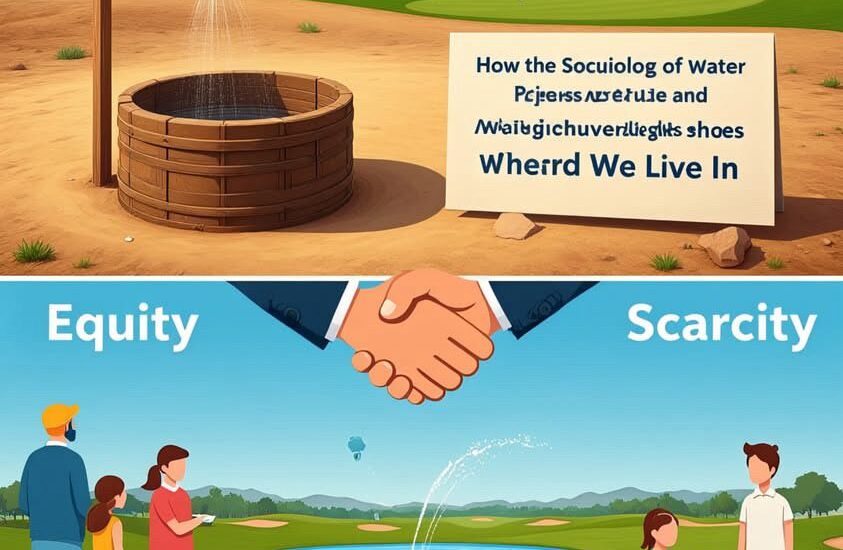
 Posted by
 Explore the sociology of water and water rights who controls water, who lacks access, and how power shapes water justice and governance worldwide. Water is everywhere, and yet somehow, it is also never quite enough. I grew up near a small river that flooded every few years, and I remember watching my neighbors argue over who was responsible for the damage each time the banks overflowed. Nobody could agree on who owned the water, who bore the cost of its excess, and who had the right to divert it for their own land. I did not have the language for it then, but what I was witnessing was the sociology of water playing out in real time the social structures, power dynamics, and human relationships that determine who controls one of the most fundamental resources on earth.
The sociology of water is a growing field of study that examines how water is distributed, managed, and contested across societies. It asks not just where water goes, but who decides where it goes and why. At its core, it is about power. Water governance is rarely neutral. The decisions made about water allocation, water access, and water rights tend to reflect the same inequalities that structure other areas of social life, such as race, class, gender, geography. Researchers who study the sociology of water resources consistently find that the people with the least political power are also the people most likely to face water insecurity.
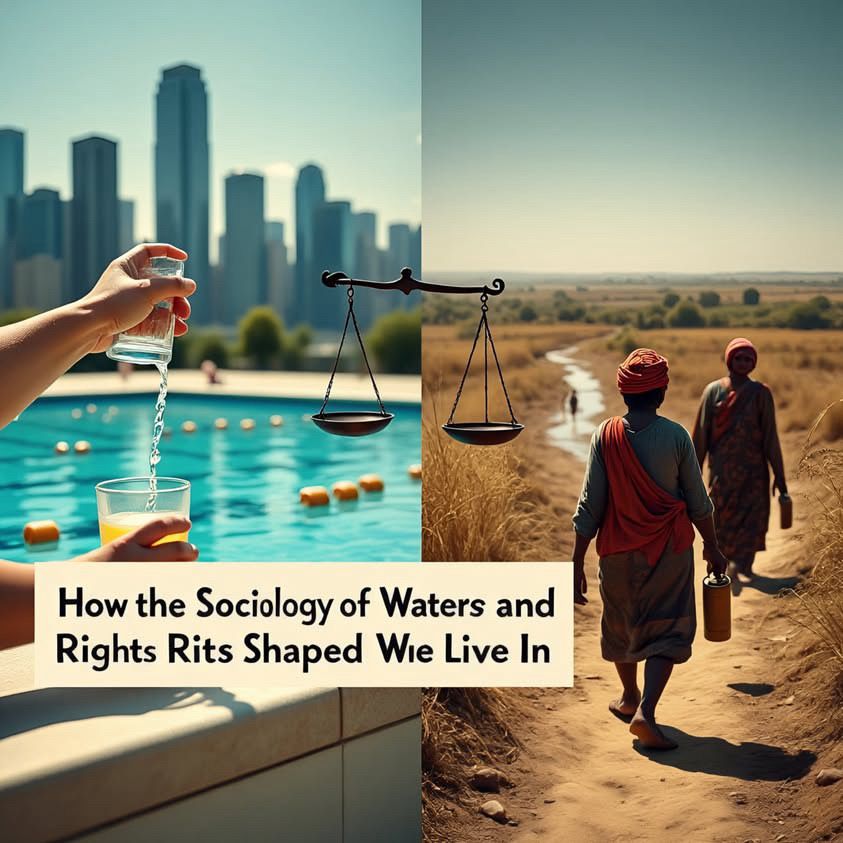
Water rights, as a legal and social concept, vary enormously around the world. In the American West, the doctrine of prior appropriation, sometimes described as “first in time, first in right,” has governed water use for well over a century. Under this system, whoever first put water to beneficial use holds the strongest claim. This sounds straightforward until you consider that the people who arrived first in the legal sense were often settlers who displaced Indigenous communities with far older relationships to those same rivers and watersheds. The sociology of water rights in the American West is inseparable from the history of colonization.
I spent some time reading about the Navajo Nation’s ongoing legal struggles for water access in the Colorado River Basin, and I found myself genuinely surprised by how unresolved those disputes remain. The Navajo Nation, one of the largest land areas of any Native nation in the United States, has some of the worst water access rates in the country. A significant portion of Navajo households still haul water from distant sources. This is not a matter of geography alone it is a matter of water justice, a concept within the sociology of water that examines how access to clean, affordable water is distributed along lines of race and historical marginalization.

Water justice is also a global concern, of course. The human right to water was formally recognized by the United Nations General Assembly in 2010, but recognition and implementation are very different things. In many parts of sub-Saharan Africa, South Asia, and Latin America, communities lack access to safe drinking water not because the water does not exist, but because the infrastructure, investment, and political will to deliver it are absent or unevenly distributed. The sociology of water access in these regions is deeply tied to questions of global inequality, foreign debt, and the privatization of water systems a contentious policy shift that has, in several documented cases, resulted in sharply higher prices and reduced access for low-income households.
The privatization debate gets at something fundamental about how societies understand water. Is water a commodity to be bought and sold, or is it a commons that belongs to everyone? This tension sits at the heart of water policy sociology worldwide. In Cochabamba, Bolivia, in the year 2000, the government’s decision to privatize the municipal water system and hand control to a multinational corporation led to massive protests, violence, and ultimately a reversal of the policy. The Cochabamba Water War, as it became known, is now a touchstone case in discussions of water commodification and social resistance. It demonstrated, in visceral terms, that water governance is never just technical it is always deeply social and political.
What strikes me most when I think about the sociology of water is how invisible these dynamics can be to people who have reliable, affordable access. I rarely think about water policy when I turn on the tap. But that invisibility is itself a kind of privilege. The communities that think about water every single day because they have to haul it, boil it, ration it, or fight for it have a fundamentally different relationship to water governance and water rights than those of us who take indoor plumbing for granted. Recognizing that gap is the first step toward taking water equity seriously as a social and political priority.
Scholars in this field argue that sustainable water management requires not just better technology or more efficient infrastructure, but a genuine rethinking of who holds power in water governance decisions.
References
Bakker, K. (2010). Privatizing water: Governance failure and the world’s urban water crisis. Cornell University Press.
Boelens, R., Getches, D. H., & Guevara-Gil, A. (2010). Out of the mainstream: Water rights, politics and identity. Earthscan.
Gleick, P. H. (1998). The human right to water. Water Policy, 1(5), 487–503. https://doi.org/10.1016/S1366-7017(99)00008-2