
 Posted by
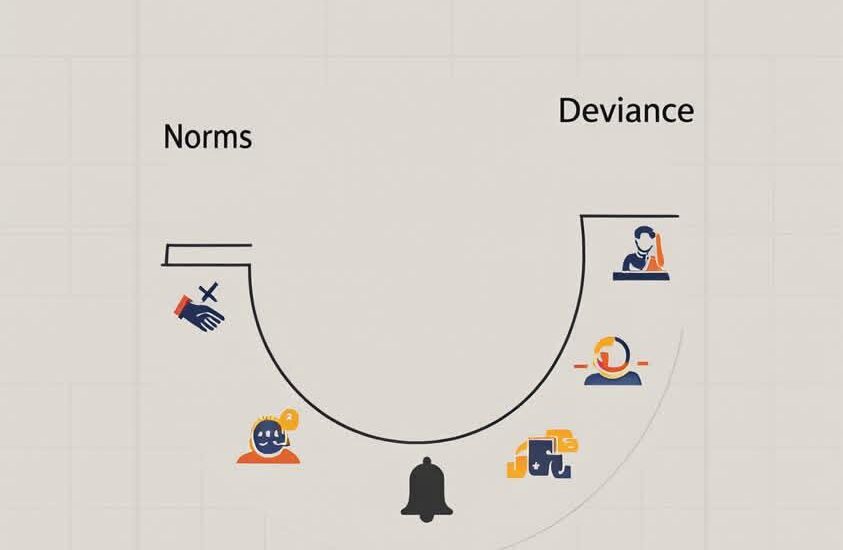
 Social deviance explains why people violate social norms and what that reveals about society. The day I truly understood what social deviance meant, not from a textbook, but from watching my uncle show up to a formal family dinner in paint-splattered overalls. Nobody said anything outright, but the sideways glances and the tight smiles communicated everything. He had violated an unspoken norm, and the room responded accordingly. That moment stuck with me. It made me realize that deviance is not just about crime or dramatic rule-breaking. It is about any behavior that strays from what a given group considers normal, and the social consequences that tend to follow.
Social deviance is a concept that sociologists have studied for well over a century, and yet it remains one of the most misunderstood ideas in the field. Most people hear the word “deviant” and immediately picture criminal behavior, mental illness, or extreme antisocial conduct. But the sociological definition is far broader and, frankly, more interesting than that. Deviant behavior simply refers to actions or attitudes that violate social norms, as any sociologist will tell you, vary enormously across time, culture, and context. What was considered deeply inappropriate in one era can become perfectly acceptable in the next. What is celebrated in one society can be punished in another.

Sociologists typically divide social deviance into two main categories: formal and informal. Formal deviance involves violations of codified laws and regulations, things like theft, assault, or fraud. These are behaviors that the state officially defines as unacceptable and attaches legal penalties to. Informal deviance, on the other hand, covers violations of unwritten social expectations. Talking loudly in a library, cutting in line, or showing up underdressed to a job interview all qualify. The consequences here are not legal but social disapproval, exclusion, embarrassment, or loss of status. Both types reveal something important: human societies are deeply invested in enforcing conformity, whether through official institutions or through the quiet pressure of everyday judgment.
One of the foundational frameworks for understanding deviance is strain theory, developed by sociologist Robert Merton in the 1930s. Merton argued that deviance often arises when there is a gap between the goals a society encourages people to pursue and the legitimate means available to pursue them. In a culture that celebrates financial success but limits upward mobility for significant portions of the population, some individuals will inevitably seek other routes to achieve those culturally valued goals. This explains why deviance is not randomly distributed across society; it tends to concentrate among groups who face the greatest structural barriers. That insight remains powerful and relevant decades after Merton first articulated it.

I think about strain theory whenever I read coverage of white-collar crime. There is a tendency to treat corporate fraud or financial misconduct as somehow categorically different from street-level crime, but the underlying logic of social deviance applies equally. The executive who manipulates earnings reports and the teenager who shoplifts from a convenience store are both, in Merton’s framework, responding to the pressure of socially defined success in contexts where legitimate pathways feel blocked or insufficient. The form of deviance differs, but the social conditions producing it share common roots. That parallel rarely gets the attention it deserves in public conversation.
Labeling theory offers another compelling lens. Howard Becker, writing in the 1960s, argued that deviance is not an inherent quality of an act itself but rather a consequence of how others respond to it. A behavior becomes deviant when it is successfully labeled as such by people with the power to make that label stick. This shifts attention away from the rule-breaker and toward the rule-makers who define what counts as deviant behavior, whose conduct gets scrutinized, and whose gets quietly overlooked. These are questions that carry real weight in discussions of criminal justice, mental health, and social inequality. Once a person is labeled deviant, that label tends to follow them in ways that shape their future opportunities and self-perception, sometimes producing exactly the behavior it was meant to discourage.
Social control theory, associated with Travis Hirschi, approaches deviance from the opposite direction. Rather than asking why some people engage in deviant behavior, Hirschi asked why most people do not. His answer centered on social bonds, attachment to family, commitment to conventional goals, involvement in mainstream activities, and belief in shared values. The stronger those bonds, the less likely an individual is to engage in deviant acts. Weaken those connections, and the restraints on behavior dissolve. This framework has obvious implications for understanding how community disruption, economic precarity, and social isolation can contribute to rising rates of deviance in specific populations.
Reference
Becker, H. S. (1963). Outsiders: Studies in the sociology of deviance. Free Press.
Durkheim, É. (1895). The rules of sociological method (S. Lukes, Ed.; W. D. Halls, Trans.). Free Press. (Original work published 1895)
Lemert, E. M. (1951). Social pathology: A systematic approach to the theory of sociopathic behavior. McGraw‑Hill.