
 Posted by
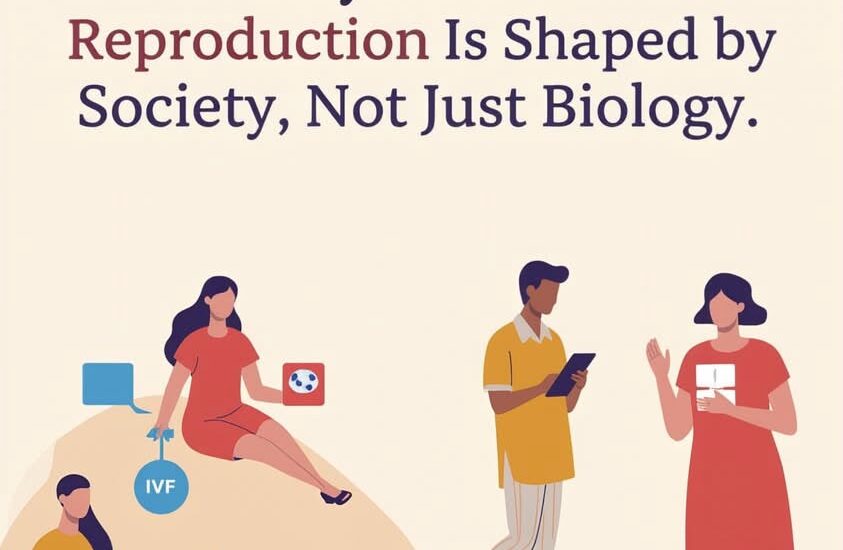
 Explore the sociology of human reproduction and fertility, from gender roles to economics, and see how society shapes our most personal family choices. I remember sitting at my cousin’s baby shower a few years back, listening to a table full of aunts debate the “right age” to have kids. One aunt swore twenty-five was ideal. Another insisted on waiting until thirty-five to make you wiser and more financially stable. Nobody at that table was a doctor or a scientist, yet everyone had strong opinions about fertility and reproduction. That afternoon stuck with me because it captures something sociologists have argued for decades: human reproduction is never just a biological event. It is a deeply social one, too.
When we talk about fertility rates, family planning, or reproductive choices, we tend to assume we are talking about bodies and hormones. And sure, biology plays its part. But the sociology of human reproduction asks a different set of questions. Why do birth rates drop in wealthier countries? Why do some cultures pressure women to have children young while others push higher education first? Why does the number of children someone has often mirror their parents’ family size rather than some universal biological instinct? These questions cannot be answered by biology alone, and that is exactly why sociology matters here.
Consider how economic conditions shape reproductive decisions. I have friends who delayed having children for years because of student debt and unstable housing markets. This is not laziness or indecision. It reflects a broader pattern researchers have tracked across industrialized nations, where the cost of raising a child, combined with career pressures, pushes people toward smaller families or none at all. Fertility rates in many developed countries have declined steadily, and economists and sociologists alike point to housing costs, childcare expenses, and shifting gender roles as major drivers. Is it any wonder that people hesitate when daycare costs rival a mortgage payment?
Gender roles deserve their own spotlight in this conversation. For most of human history, reproduction was tied tightly to womanhood itself, almost as if a woman’s value depended on her ability to bear children. Thankfully, that narrative has been challenged, though not erased, in many parts of the world. Sociologists studying reproduction closely examine how patriarchal structures influence who gets blamed for infertility, who bears the emotional and physical labor of pregnancy, and who is expected to sacrifice career ambitions for parenthood. My own mother once told me she felt judged for returning to work six weeks after having my brother. That kind of social pressure, whether spoken aloud or just implied through raised eyebrows, shapes reproductive behavior just as much as any hormone does.

Religion and cultural tradition add another layer entirely. Some communities view large families as a blessing or a religious duty, while others see smaller families as a marker of modern success. I grew up around families who had six or seven siblings simply because that was the norm in their community, and I also know people who feel societal pressure to justify why they only want one child, or none at all. Reproductive norms are passed down the way recipes are passed down in families, quietly, often without explicit instruction, yet somehow everyone absorbs the rules anyway.
Technology has complicated things further, and honestly, it fascinates me. Assisted reproductive technology, birth control access, and even social media have reshaped how people think about family planning. Birth control alone shifted the conversation from “when will children arrive” to “if and when we choose them to arrive.” That shift, more than almost anything else, handed people agency over their reproductive timelines. Sociologists often describe this as one of the most significant social changes of the last century, right up there with shifts in labor and education. Meanwhile, IVF and other fertility treatments have opened paths to parenthood for people who once had none, though access remains uneven and expensive, which is its own sociological story about inequality.
Then there is the state itself. Governments do not sit on the sidelines when it comes to human reproduction and fertility trends. Policies around parental leave, tax incentives for having children, and even restrictions on reproductive healthcare all send signals about what a society values. Some countries offer generous subsidies to encourage people to have more children, worried about aging populations and shrinking workforces. Others restrict access to contraception or abortion, shaping reproductive choices through law rather than persuasion. It is hard to separate personal choice from political context when the two are so tangled together.
What strikes me most, after all this reading and reflecting, is how reproduction sits at this strange intersection of the deeply personal and the intensely public. Deciding whether to have a child feels like one of the most private decisions a person can make, yet it is constantly shaped by economics, gender expectations, religion, technology, and government policy. My cousin’s baby shower debate was never really about the “right age” to have kids. It was about all these invisible social forces bumping up against one another at one kitchen table.
Reference
Centers for Disease Control and Prevention. (2023). 2021 assisted reproductive technology fertility clinic and national summary report. U.S. Department of Health and Human Services. https://www.cdc.gov/art/reports/2021/
Doepke, M., Hannusch, A., Kindermann, F., & Tertilt, M. (2022). The economics of fertility: A new era (NBER Working Paper No. 29948). National Bureau of Economic Research. https://www.nber.org/system/files/working_papers/w29948/w29948.pdf
Kearney, M. S., & Levine, P. B. (2025). Why is fertility so low in high-income countries? (NBER Working Paper No. 33989). National Bureau of Economic Research. https://www.nber.org/system/files/working_papers/w33989/w33989.pdf