

 Posted by
 Explore how race and immigration shape national identity, revealing the political choices behind who belongs and who remains perpetually foreign in any nation. I remember the first time someone asked me where I was really from. I had just told them I grew up in Ohio, but apparently that was not the answer they were looking for. The question hung in the air between us, loaded with assumptions about what an American is supposed to look like. That moment stuck with me because it revealed something fundamental about how we construct national identity and how race and immigration sit at the very heart of that construction.
National identity feels permanent, like something etched in stone and passed down through generations. We talk about it as if it were natural, inevitable even. But the truth is far messier and more interesting. The idea of who belongs to a nation and who does not is constantly being rebuilt, reimagined, and fought over. Race and immigration are not just side issues in this process. They are the primary tools we use to draw the boundaries of belonging.
Think about how nations tell stories about themselves. These narratives almost always involve some notion of a core group of people who represent the authentic version of that nation. In the United States, this has historically meant white, English-speaking Protestants. Never mind that this country was built on Indigenous land and by enslaved people brought from Africa. Never mind the waves of immigrants from Ireland, Italy, China, Mexico, and everywhere else who shaped the economy and culture. The idealized American in popular imagination has been remarkably consistent, and that consistency depends on treating whiteness as the default setting for belonging.
I find it fascinating how immigration policy has always been about more than just managing borders. It has been a way of deciding what the nation should look like in the future. The Chinese Exclusion Act of 1882 was not merely about labor competition or economic anxiety. It was about preserving a particular racial character of the nation. The same can be said for the Immigration Act of 1924, which established quotas designed to favor Northern and Western Europeans while severely limiting people from Southern and Eastern Europe, Asia, and Africa. These were not accidental choices. They were deliberate attempts to engineer the racial composition of the country.
What strikes me most about these historical examples is how they reveal the circular logic of national identity. We create laws that favor certain groups, those groups become dominant in society, and then we point to their dominance as evidence that they represent the true character of the nation. Anyone who does not fit that mold becomes perpetually foreign, no matter how many generations their family has lived here. This is why Asian Americans can still be asked where they are really from, why Latino families who have been here for centuries are told to go back where they came from.
The construction of national identity through race and immigration is not unique to the United States, of course. Look at how European nations have struggled with their increasing diversity. France insists on a colorblind republicanism that refuses to acknowledge race, yet somehow North African immigrants and their descendants find themselves systematically excluded from full participation in French society.
Germany spent decades defining citizenship through blood rather than birthplace, making it nearly impossible for Turkish immigrants to become German no matter how long they lived there. Britain built an empire that spanned the globe, yet expressed shock and dismay when people from former colonies actually showed up on British shores claiming their rights as Commonwealth citizens.
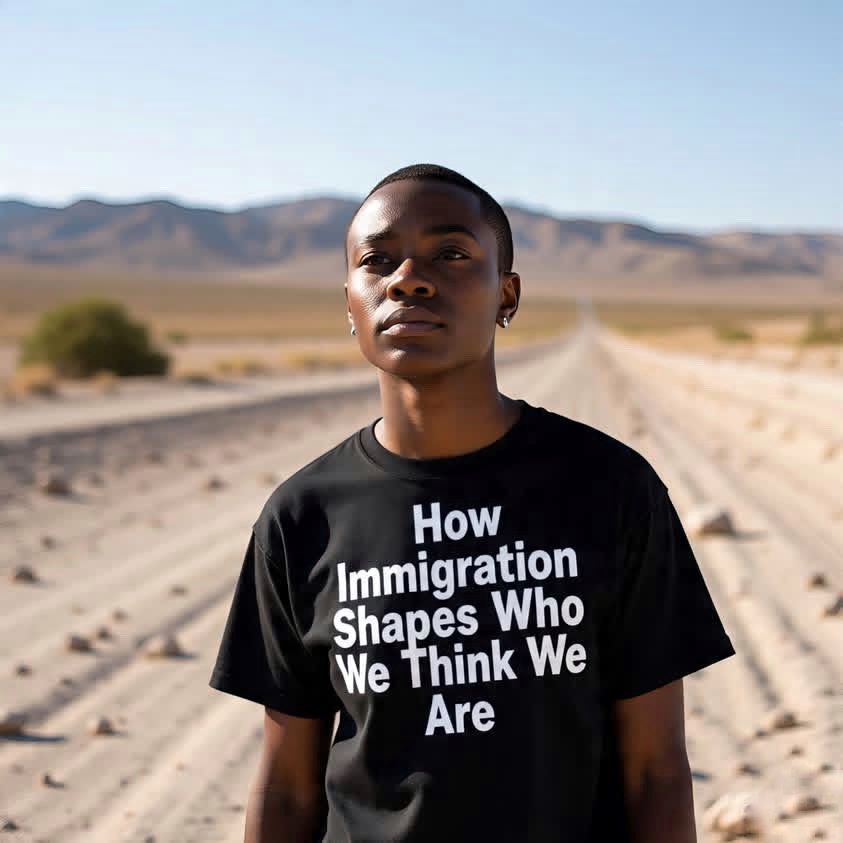
These Image that describes How Immigration Shapes Who We Think We Are: Race, Borders, and Belongingcontradictions are not bugs in the system. They are features. National identity needs to be both inclusive enough to inspire loyalty and exclusive enough to maintain hierarchies. Race provides the perfect mechanism for this balancing act because it can be made visible or invisible depending on what the moment requires. When a nation needs workers, immigration restrictions loosen and diversity gets celebrated as strength. When economic anxiety rises or political winds shift, suddenly those same immigrants become threats to national security or cultural cohesion.
I often wonder what it would look like if we were honest about this process. What if we acknowledged that national identity has always been a political project rather than a natural fact? What if we recognized that the boundaries we draw around who belongs are choices we make rather than eternal truths we discover? This does not mean nations are meaningless or that borders should not exist. It means we could make different choices about how we define belonging.
The conversation about race and immigration will never be just about policy. It cuts too deep into our sense of who we are and who we want to be. Every time we debate immigration reform or discuss demographic changes, we are really arguing about the fundamental question of what it means to be us. The immigrants arriving today will shape the national identity of tomorrow, just as previous waves of immigrants did before them. The question is whether we will recognize them as part of the national story or continue to treat them as perpetual outsiders.
Reference
Anderson, B. (1983). Imagined communities: Reflections on the origin and spread of nationalism. Verso.
Bonilla-Silva, E. (2003). Racism without racists: Color-blind racism and the persistence of racial inequality in the United States. Rowman & Littlefield Publishers.
U.S. Congress. (1882). Chinese Exclusion Act, 47th Congress, Session I, Chapter 126. U.S. Government Printing Office. https://www.govinfo.gov/content/pkg/STATUTE-22/pdf/STATUTE-22-Pg58.pdf