
 Posted by
 There was a day, I sat in on a rehearsal for a community orchestra in a mid-sized city. What struck me was not the music itself but everything happening around it: who was holding what instrument, who was giving direction, who stayed after to chat with the conductor, and who quietly packed up and left. Music making, I realized then, is never just about sound. It is a profoundly social act, and the sociology of music offers some of the most illuminating tools we have for understanding why. Sociology of music reveals how class, race, and gender shape who gets to make music and what that means for identity, culture, and creative power.
The sociology of music is concerned with how musical production, consumption, and participation are shaped by the societies in which they occur. It asks questions that go far beyond taste or talent. Who has access to music education? Whose musical traditions get institutionalized and whose get dismissed? How do class, race, and gender determine not only the music people listen to but also the music they are allowed to make? These are not abstract academic puzzles. They are questions with real consequences for real musicians.
One of the foundational ideas in this field comes from Pierre Bourdieu, whose concept of cultural capital has become almost unavoidable in discussions of music and social reproduction. Bourdieu argued that familiarity with certain cultural forms, classical music being the quintessential example, functions as a form of capital that can be accumulated and exchanged within social fields. A child who grows up attending concerts, taking piano lessons, and hearing Bach discussed at the dinner table arrives at school with a set of dispositions that quietly mark them as educated, refined, and belonging. This is not neutral. It is a mechanism of social distinction that consistently benefits those who are already privileged.
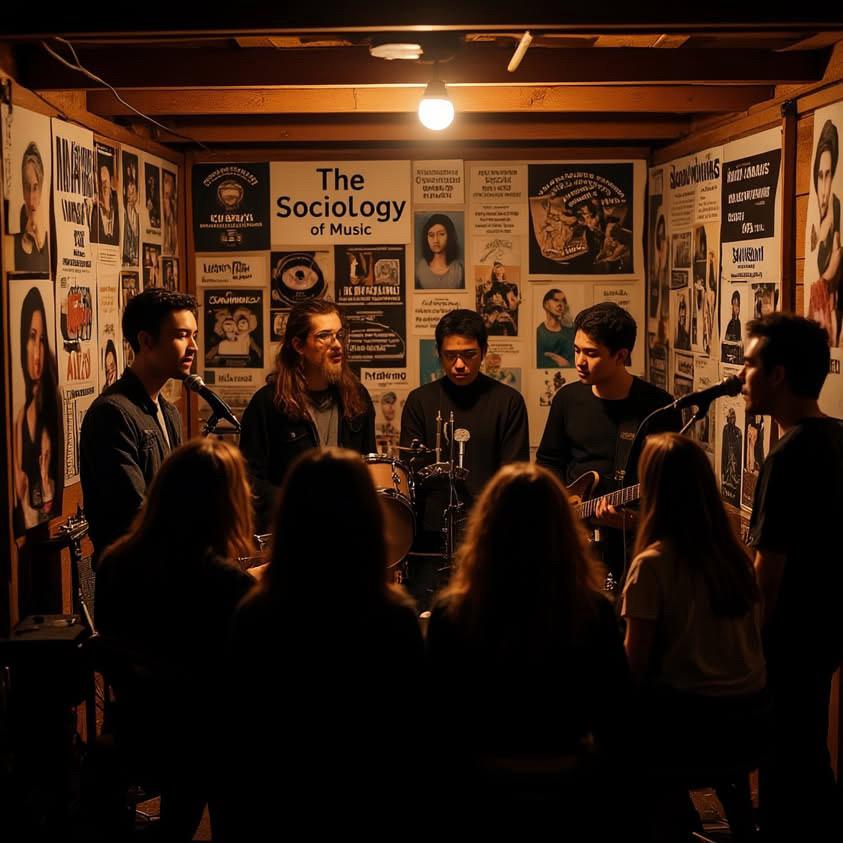
What this means in practice is that music education, particularly formal music education, tends to reproduce existing inequalities. Schools in wealthier districts have orchestras. Schools in underfunded areas often have nothing. I think about a friend of mine who grew up in a rural county where the only instrument available in school was a battered plastic recorder. She is one of the most musically gifted people I know, but her path into music making required a set of detours and self-education efforts that most conservatory-trained musicians never had to navigate. The sociology of music production is, in part, the study of these structural barriers.
And yet the picture is never entirely bleak, because music making also has a remarkable capacity to emerge from the margins. Hip-hop is perhaps the most discussed example in contemporary sociological literature, and for good reason. Originating in the South Bronx in the 1970s among Black and Latino youth with limited access to formal musical infrastructure, hip-hop developed an entire aesthetic and technical vocabulary out of turntables, breakbeats, and the spoken word. Sociologists like Tricia Rose have examined how hip-hop was not only a cultural form but a response to urban disinvestment, a way of claiming space and voice within a society that was actively withdrawing resources from Black communities. Music making, here, becomes a form of social commentary and collective identity formation.
The sociology of musical identity is another rich strand of this conversation. Music does not just reflect who we are; it actively helps construct who we are. This is especially visible in adolescence, when musical taste and participation become central to peer group formation and self-definition. Think about the role that punk played for working-class British youth in the late 1970s, or the way that regional music scenes in cities like Detroit, Chicago, and New Orleans have consistently produced sounds that are inseparable from the social conditions that generated them. Musical subcultures are not just entertainment; they are sites where people negotiate belonging, resistance, and identity.
Gender is another axis that the sociology of music making cannot ignore. The consistent underrepresentation of women in certain musical roles as producers, as conductors, as lead guitarists is not accidental. It reflects a broader set of cultural assumptions about who is authoritative, who is technical, and whose creativity deserves institutional support. Research in music sociology has documented how women musicians often face heightened scrutiny of their technical abilities, are more frequently evaluated on appearance, and are systematically steered toward certain instruments and away from others from childhood onward. The sociology of music and gender is, in this sense, really the sociology of power.
What I find most compelling about this field is how it forces us to sit with a kind of productive discomfort. We like to imagine music as a universal language, as something that transcends social division. And in certain moments, a crowd singing together at a concert, a jazz improvisation where players from radically different backgrounds find a common groove, that feeling is real.
Reference
Bourdieu, P. (1984). Distinction: A social critique of the judgement of taste (R. Nice, Trans.). Harvard University Press.
National Endowment for the Arts. (2016). Creativity connects: Trends and conditions affecting U.S. artists. https://www.arts.gov/sites/default/files/Creativity-Connects-Final-Report.pdf
Lena, J. C., & Peterson, R. A. (2008). Classification as culture: Types and trajectories of music genres. American Sociological Review, 73(5), 697–718. https://doi.org/10.1177/000312240807300501