
 Posted by
 I have spent a lot of time thinking about why people get so competitive about things that should not really be competitive at all. You know the type. The colleague who refuses to share information because they think it might give someone else an edge. The parent who views every slot on the soccer team as a personal battle.
The person who seems genuinely bothered when something good happens to someone else, as if that success somehow diminishes their own chances. I used to have a neighbor like this. Every time I mentioned something positive happening in my life, a freelance project landing or a nice weekend away.
He would respond with some comment about how things were tough for him right now. It took me years to understand that he was not simply venting. He genuinely believed that my good fortune came at his expense, as if the universe had a fixed quota of happiness and I was hogging more than my share.
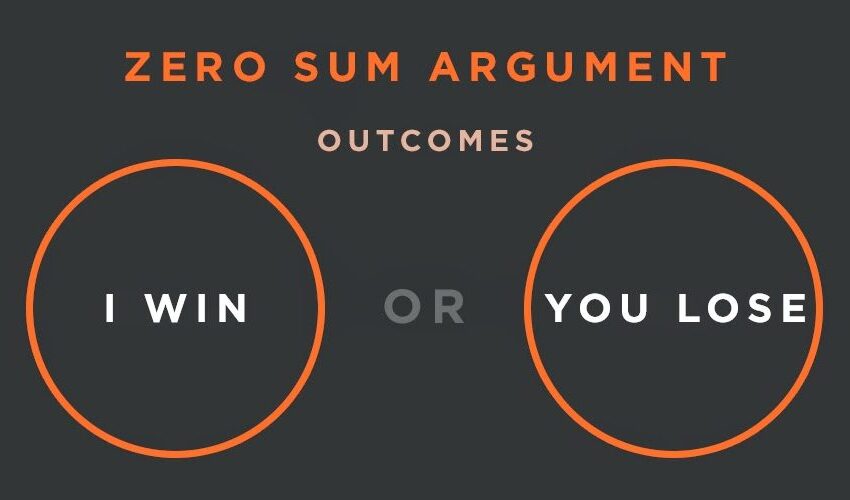
That is zero-sum thinking in its purest form. In this exploration of zero-sum thinking and social competition, I want to examine why so many of us fall into this cognitive trap and how understanding its mechanics might help us escape it.
Here is the thing about zero-sum logic. It sounds completely reasonable until you examine it closely. The basic premise is simple. If there is only so much pie to go around, every piece someone else takes leaves less for me. In strict mathematical terms, economists define zero-sum games as situations where the total gains and losses across all participants add up to zero.
A poker table works this way. Money moves between players but the total amount in the game does not change. My win is literally your loss. The trouble starts when people apply this poker logic to domains that do not work that way. National economies can grow. Scientific knowledge expands. Social trust builds over time. These are not fixed pies.
When I learn something new, I have not stolen that knowledge from anyone else. When my neighbor gets a promotion, it does not reduce my chances of professional success in any direct way. And yet the zero-sum frame persists, sometimes with destructive consequences.
I catch myself doing it too, more often than I would like to admit. Scrolling through social media, seeing someone announce a book deal or a new job, feeling that twinge of something that looks a lot like envy. The rational part of my brain knows their success has nothing to do with me. The more primitive part whispers that they are winning and I am losing.
Sociologists have spent decades studying why status competition feels so zero-sum even when resources are expanding. The concept of positional goods helps explain this. Some things derive their value precisely from being scarce. Prestige works this way. Elite university credentials work this way. Desirable neighborhoods work this way.
When everyone has these things, they stop meaning as much. This creates a structural problem that individual awareness cannot easily solve. Even if I understand intellectually that cooperation benefits everyone, the logic of positional goods pulls me toward competition. If my kid gets into the same college as everyone else, that credential loses its edge.
I do not like this dynamic. I did not create it. But pretending it does not exist does not make it go away. The consequences of zero-sum thinking extend far beyond personal relationships. Research by political psychologist Nour Kteily and colleagues has shown that zero-sum beliefs about competition between groups predict some ugly outcomes.
People who believe one group’s advancement necessarily means another group’s decline tend to hold more prejudiced views. They oppose redistribution more strongly. They support exclusionary policies. This makes intuitive sense when you think about it.
If immigration is a zero-sum game, then immigrants taking jobs means locals losing jobs. If civil rights advances are zero-sum, then expanded rights for one group mean diminished status for another. The logic creates opposition to policies that might actually expand the pie for everyone because the frame only permits one possible outcome.
There are winners and there are losers. No other possibility exists. I have had conversations with people who hold these views strongly. The frustrating thing is that within their own frame, they are being perfectly logical. If you accept the premise that everything is a competition for fixed resources, then protecting your position becomes a moral duty.
The error is not in their reasoning. The error is in the premise itself. So what breaks this pattern? I used to think education was enough. Teach people how zero-sum logic misleads them and they will stop using it. I no longer believe that. The persistence of zero-sum thinking comes partly from the fact that it is sometimes right.
In a job market with only three openings and fifty applicants, competition is genuinely zero-sum in the short term. The person who gets the job won and everyone else lost. The frame that helps you understand that situation distorts your thinking when applied to situations where the pie can grow. Real change requires more than individual insight.
It requires environments where cooperative payoffs become visible and credible. When people can actually see that someone else’s success creates conditions for their own success, the logic shifts. That might mean workplaces that reward collaboration instead of individual competition. It might mean communities where shared gains are obvious and celebrated.
It might mean political structures that make expanding the pie the obvious goal rather than fighting over the existing slices. Building those conditions is hard work. It is political work. It is structural work. But I have come to believe it is the only work that matters for escaping the zero-sum trap.
The sociology of competition leads back to the institutions that shape what kind of competition is even possible. Change those institutions and you change what people compete for and how they compete. I think about my old neighbor sometimes and wonder what made him see the world that way. Maybe his experiences had taught him that gains really were scarce.
Maybe the institutions around him only rewarded winners and punished losers. Maybe he just never saw an example of cooperation creating something new rather than just redistributing what already existed. Whatever the cause, his frame shaped his reality. That is the final lesson of zero-sum thinking. Believe it strongly enough and you will create the scarcity you fear. The real challenge is building a world where that belief no longer makes sense.
References
Kteily, N. S., et al. (2017). Predator or prey? Perceptions of a zero-sum competition predict prejudice and discrimination. Journal of Personality and Social Psychology, 112(6), 1022–1040. https://doi.org/10.1037/pspi0000089
Frank, R. H. (1999). Luxury Fever: Why Money Fails to Satisfy in an Era of Excess. Free Press. https://www.simonandschuster.com/books/Luxury-Fever/Robert-H-Frank/9780684842097
Hirsch, F. (1976). Social Limits to Growth. Harvard University Press. https://www.hup.harvard.edu/books/9780674813991
Rubin, P. H. (2002). Darwinian Politics: The Evolutionary Origin of Freedom. Rutgers University Press. https://www.rutgersuniversitypress.org/darwinian-politics/9780813531700
Merton, R. K. (1968). Social Theory and Social Structure. Free Press. https://www.simonandschuster.com/books/Social-Theory-and-Social-Structure/Robert-K-Merton/9780029211304