

 Posted by
 Understand social integration and exclusion, from immigration and poverty to digital life and workplaces, with real examples and honest reflection. I still remember standing at the edge of a community potluck a few years back, plate in hand, watching little clusters of people who clearly already knew each other. Nobody was rude. Nobody pointed or whispered. And yet I felt it, that particular ache of being physically present but socially invisible. That moment taught me more about social exclusion than any textbook ever did, and it is the reason I keep coming back to this topic whenever I write about sociology.
Social integration, at its core, is the process by which individuals become woven into the fabric of a group, a community, or a society. It is not just about being counted as a member on paper. It is about feeling like your presence matters, like you have a role, like people would notice if you stopped showing up. Sociologists have studied this for over a century, starting with Durkheim, who argued that a lack of integration was one of the root causes of what he called anomic suicide. Heavy stuff for a blog post, I know, but it sets the stage for why this topic deserves more attention than it usually gets.
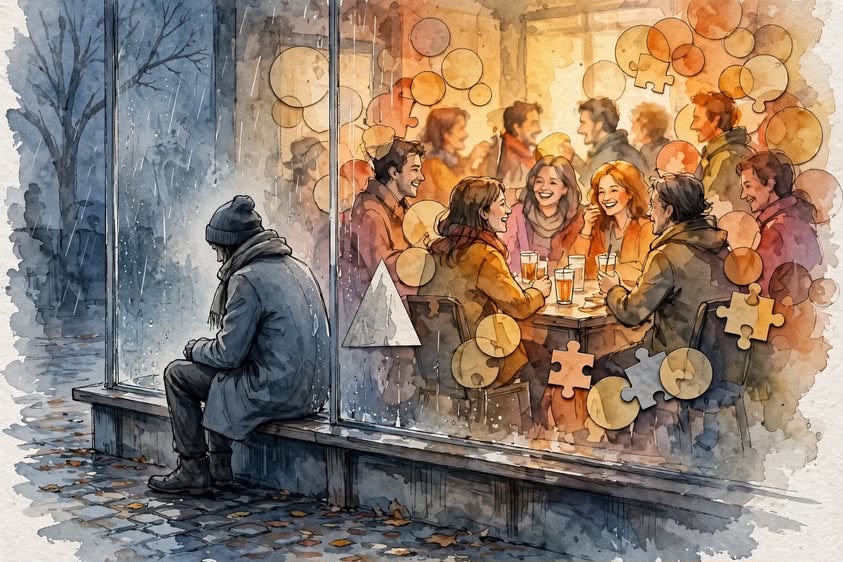
Exclusion, on the other hand, does not always announce itself loudly. Sometimes it is a closed door. Other times it is a thousand small gestures, an unreturned invitation, a joke you do not understand, a language barrier nobody bothers to bridge. Have you ever noticed how exclusion often hides behind politeness? People rarely say “you do not belong here.” Instead they just quietly stop including you, and you are left wondering whether you imagined the whole thing.
I think about this a lot in the context of immigration and migration, since so much of the sociological literature on integration centers on how newcomers adapt to a host society. There is a classic distinction between assimilation, where a person adopts the dominant culture almost entirely, and multiculturalism, where different cultural identities are allowed to coexist within one society. Neither approach is perfect, honestly. Assimilation can feel like erasure, while. multiculturalism, without real structural support, can slide into parallel lives that never actually touch. The healthiest version of integration probably sits somewhere in the middle, a kind of mutual accommodation where both the newcomer and the existing community change a little.

Economic exclusion deserves a mention too, because poverty and social exclusion are so tightly linked that separating them almost feels artificial. When someone cannot afford to participate, cannot make it to the school fundraiser, cannot dress the way the group expects, cannot take unpaid time off for the neighborhood cleanup, they get pushed to the margins even if nobody intends to push them there. I once worked with a nonprofit that ran after school programs, and the biggest barrier was never interest. It was transportation. Kids wanted to come. Their families simply could not get them there. That is structural exclusion in its plainest form, and it rarely gets the attention that more dramatic forms of discrimination receive.
Digital life has added a strange new layer to all of this. Social media promised connection, and it does deliver some of that, do not get me wrong. But it has also created new categories of exclusion, the group chat you were quietly removed from, the online community with its own dialect and inside jokes that make outsiders feel instantly foreign. I sometimes wonder if we have simply moved the potluck online, same dynamics, different platform. What actually helps people feel integrated? Shared activities seem to matter more than shared values, at least in my own observation. You do not need to agree with your neighbor about politics to feel connected to them if you have spent years coaching the same youth soccer team together. Repeated, low stakes interaction builds trust in a way that grand statements about diversity and inclusion rarely manage on their own. Community centers, local sports leagues, religious congregations, even a regular coffee shop where the barista knows your order, these ordinary touchpoints do quiet, unglamorous work that keeps a society stitched together.
Schools and workplaces carry enormous responsibility here as well, since they are often the first real testing ground for whether integration policies work in practice or just look good in a mission statement. A workplace can claim to value diversity while still promoting mostly along familiar social lines, mentorship going to whoever reminds a manager of their younger self. That is exclusion wearing a very professional outfit.
I do not think exclusion will ever fully disappear, if I am honest. Humans form in-groups almost instinctively, it seems to be part of how our brains manage a complicated social world. But awareness changes things. Once you notice the mechanics of exclusion, the small gestures, the structural barriers, the economic gatekeeping, you start noticing when you have the power to open a door instead of letting it swing shut. Maybe that is the real work of social integration, not some grand policy fix, but a thousand small decisions to save someone a seat at the potluck table.
Reference
Durkheim, É. (1897). Le suicide: Étude de sociologie. Félix Alcan.
Durkheim, E. (1893/1984). The division of labour in society (W. D. Halls, Trans.). Free Press. (Original work published 1893)
Sedláček, J. (1994). The concept of anomie within Durkheim’s sociology. Sociologický časopis / Czech Sociological Review, 30(2), 135–146.